
SPEAKING
Ten practical things about agentic AI
Ten things to carry out of the room, from running AI at enterprise scale rather than from writing about it.
Modev · Arlington, Virginia · October 2026
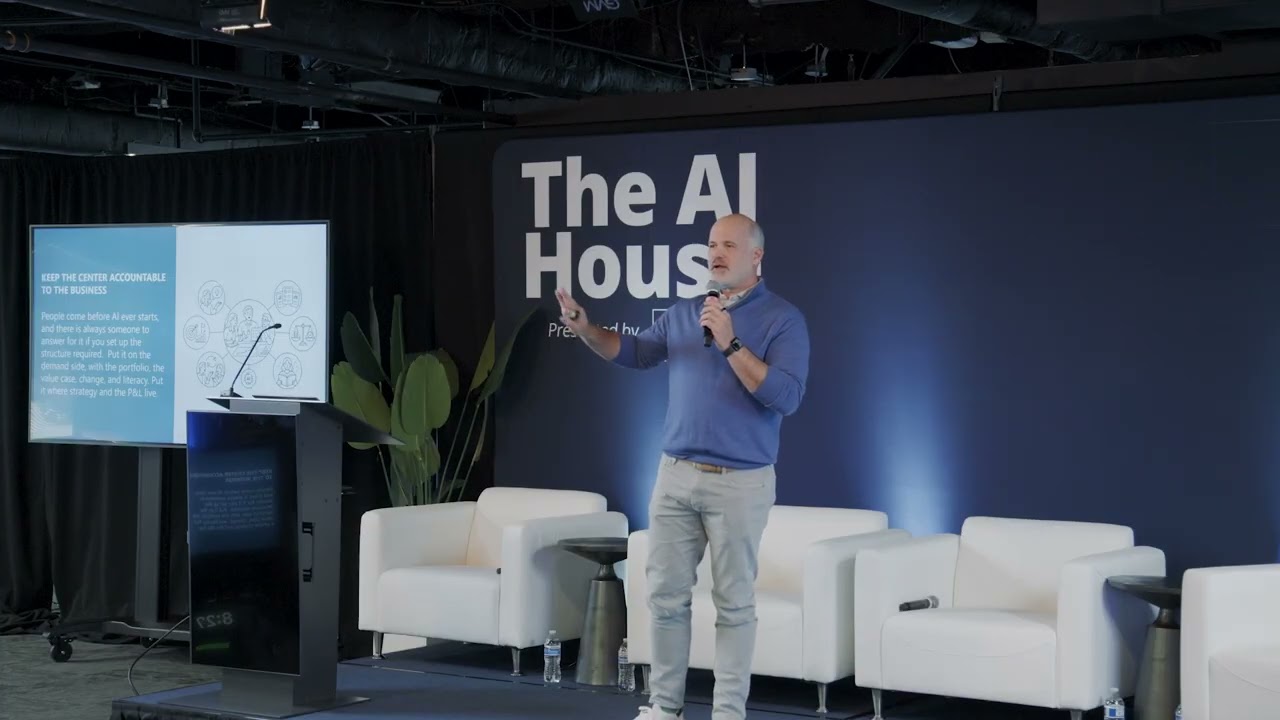
Most of what gets said about agentic AI is written by people who have not had to put it in front of a regulator, a works council, or a customer. The ten below come from the other side of that: sixteen years in global consulting, then building and running the AI function at a Fortune 500 operator.
They are ordered the way the talk is delivered. Nothing here needs a platform decision or a budget cycle to act on.
The ten
Treat AI as a socio-technical system
The model is one component. Workflows, guardrails, UX, governance, training and feedback loops matter at least as much. Most failures are not model failures.
Treat every use case as a shippable product
A product has a lifecycle, scales with the rest of your AI, carries input and output controls, stays measurable and cost-controlled, and remains maintainable. Build for the day you have to replace it.
Keep the center accountable to the business
Put it on the demand side, with the portfolio, the value case, change and literacy. Put it where strategy and the P&L live.
Invest early in governance and platforms
Clear policy, an approval path, and a shared platform with strong default model and cloud choices. Without it you get paralysis or chaos. With it, the conditions for compounding.
Be disciplined about the portfolio
The hardest part of running a council is saying no to smart people with good ideas at the wrong time. Kill stuck proofs of concept: if one cannot prove value in four to six weeks, move on.
Be intentional about build versus buy
Could you build it in under six months? Is the capability too narrow to cover an end-to-end value stream? Will it fit real user needs, or force process changes that never happen? Vendor sprawl costs more than you see.
Pick foundation-model partners that take safety seriously
It sounds obvious. It is the single biggest determinant of whether your AI program is something you can put in front of customers and regulators with confidence.
Keep humans in the loop, lead with augmentation
Focus on augmenting people before replacing them. Trust gets built one shipped product at a time.
Measure and learn iteratively
Do not wait for a multi-year transformation plan. Run small, well-instrumented pilots that prove value, then scale. The organizations that win learn fastest under good guardrails, not the ones that start biggest.
AI is not an IT project
Run AI as a business transformation, owned by the business and shaped as products, with change management built into the work. Run as an IT delivery effort, it ships software and stops short of the operating-model change where the value lives.
Analytics
We count visits with Google Analytics, which sets a cookie on your device. You can turn it off here or from the Cookies link in the footer, any time.